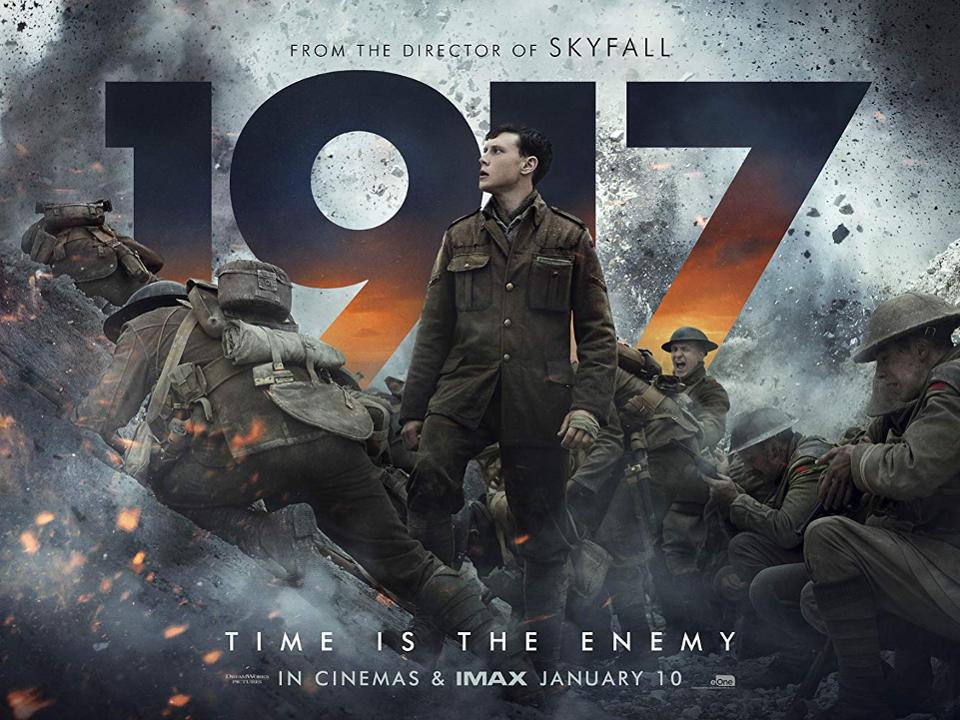
A palpable sense of dread and gloom looms over Sam Mendes’s ‘1917’; the inherently horrific wartime scenario coupled with the sheer unpredictability of the situation in which its protagonists find themselves creates a cinematic experience that is exhilarating and disconcerting in equal measures.
In April 1917, the major countries of the world are embroiled in the First World War. Troops of the Imperial German Army have mysteriously evacuated themselves from a portion of the Western Front in northern France. Two young British soldiers, Lance Corporals William Schofield and Thomas Blake, are told that aerial reconaissance has observed that the Germans are not retreating, as the Allied Forces might have hoped; instead, they are executing a tactical withdrawal by shifting their troops to their new Hindenburg Line, where they intend to lure Allied troops for the pupose of bombarding them with artillery. With field telephone lines indefinitely impaired, Schofield and Blake must travel through no man’s land and reportedly abandoned German territory to physically deliver a message to the Second Battalion of the Devonshire Regiment to cease their planned morning attack, which, if implemented, will lead to the deaths of 1600 soldiers, including Blake’s elder brother Lieutenant Joseph Blake.
Although the film does not associate itself too explicitly with its larger historical context, a perfunctory understanding of the geopolitical conditions of the time might enhance the viewing of the film. In February 1917, the War was almost reaching a point of perplexing stagnation on the Western Front; the Allies and the Central Powers were brutally combating each other’s forces, but neither side was making substantive progress towards securing victory. A prolonged stalemate was threatening each side’s hopes of securing an upper hand. It was at this time that German General Erich Ludendorff ordered for Operation Alberich to be executed, which meant that German troops would be strategically withdrawn and shifted to the newly built and fortified Hindenburg Line, thus consolidating their forces in preparation for more impactful offensive operations (such as Operation Michael, a campaign in the spring of 1918 that entailed the Germans breaking through British lines and advancing farther to the West than they had ever gone before, and it was not till the 29th of September in 1918 that the Allies could infiltrate the Line). This created a period of terrifying confusion amongst the Allies, who were uncertain as to whether or not the Germans had truly retreated, and if they had, it was unimaginably difficult to gauge what the reason behind an abrupt retreat of the sort might have been.
Mendes and co-writer Krysty Wilson-Cairns utilise this stupendous confusion to propel the narrative, and to create the looming suspense that the film houses. Even in the most seemingly mundane moments, the viewer cannot help but clasp their armrest in anxious anticipation of a thousand things that might imperil the protagonists. The essential story is uncomplicated, but there is enough vigour in its mobility to mask the plot’s simplicity. The dialogue-writing is delicate and succinct; the film is not verbose in the least, but the dialogue is not insufficient; it is expository enough to convey the humanity of the characters without straying into a territory that would jeopardise its realist approach. Besides, there is something hauntingly disarming about observing two justifiably jittery individuals jesting casually with each other while flirting with violent demise in every moment.
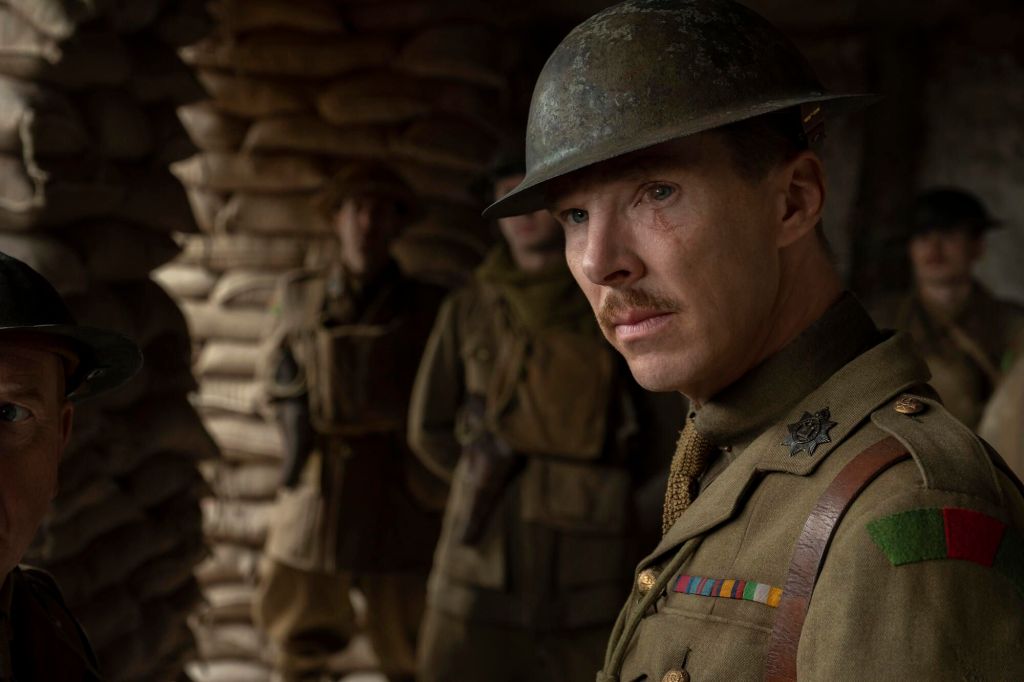
The undeclared heroes of the film, however, are cinematographer Roger Deakins, editor Lee Smith, and production designer Dennis Gassner. It is gleefully astonishing to see the fierce passion with which the technical aspects of the film bury themselves into the narrative, to create an awe-inspiring ambience. The film is designed to look as if it is shot in a single continuous take, and this is achieved through (particularly) long shots, dexterous editing, and the well-timed choreography of shots. The combined effect of the constantly mobile characters and the illusion of the one-take technique necessitates the visual scapes to not wander too far beyond the central characters; we are either observing what they are witnessing, or we are observing them witnessing it. This creates a paradoxical immersion-alienation duality; while it becomes naturally easier for us to immerse ourselves in the world of the film, the enormity of the setting’s implications also becomes subconsciously prominent. The brilliant cinematography is lovingly tended to by the editing, which surreptitiously makes the film’s ambitions attainable. Aside from one specific point in the film, it is nigh impossible to indicate where the cutting room floor has been in use. The production design is meticulously expansive and unfathomably difficult to fully grasp; the sets seemingly extend for hundreds of miles, and the spatial continuity between the varied landscapes is never disrupted. The effective musical score by Thomas Newman contributes significantly to the creation of this ambience. The artifice, in summation, is wonderfully intricate.
In terms of its performances, the acting prowess of its central duo is on full display; George MacKay as Schofield and Dean-Charles Chapman as Blake embody a complex concoction of vulnerability, fear, and valour. MacKay, in particular, shines in moments of reluctance; it is almost as if his character is reluctantly and forcefully obstructing his instinctual drive in favour of letting his sense of duty thrive, and this is portrayed superbly by the actor. Certain well-established and well-known faces, such as Colin Firth, Andrew Scott, and Benedict Cumberbatch, are also present in minor (but significant) roles, as if the makers were cheekily attempting to remind the audience that it is a “major motion picture”, after all.
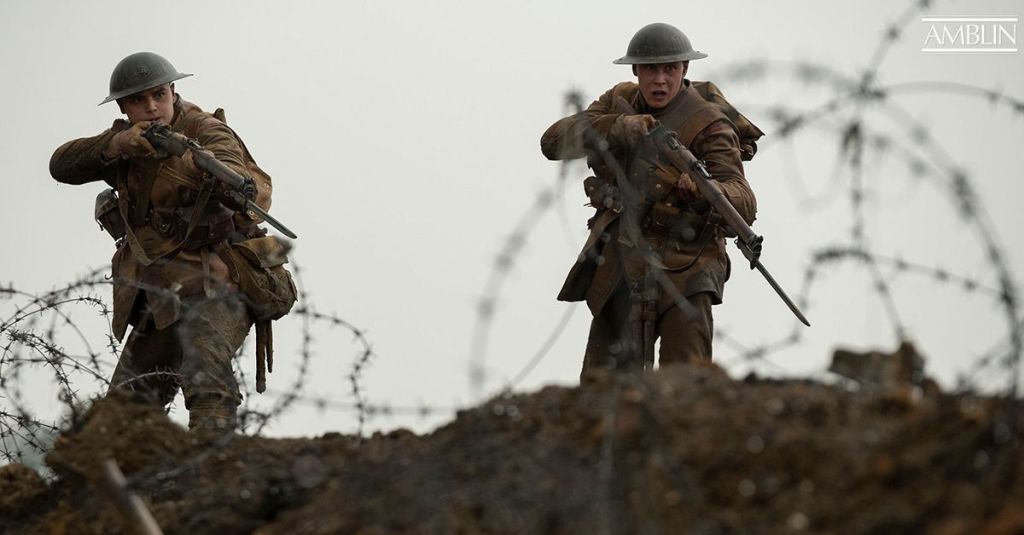
The film is perceptibly evocative of several decorated war films of the past, such as Stanley Kubrick’s ‘Paths of Glory’ (1957), Steven Spielberg’s ‘Saving Private Ryan’ (1998), and even Christopher Nolan’s ‘Dunkirk’ (2017), the last of which which can be cited as a major reference for this film’s visual aesthetic. However, the film never feels like derivative drivel, despite the potential pitfalls of its formulaic framework, and that is primarily because of its undeniable technical merit. The film’s approach to the horrors of warfare is also noteworthy; there is no sermonising about the futility of warfare, and no deafening music to accompany gimmicky shots of ghastly violence. Instead, we are subjected to horrifying sights casually strewn around the frames, creating a phantasmagoric post-apocalyptic landscape and equating a war-stricken world to it; detached tree stumps, skeletal/rotting human corpses, other deceased animals/rodents, mud lakes, abandoned cottages, disintegrated craters, etc. None of these are intended to dominate the frame; they exist simply as wistful reminders of what war takes from us.
“[The film] bears witness to the staggering destruction wrought by the war, and yet it is a fundamentally human story about two young and inexperienced soldiers racing against the clock”, Mendes said of the film to Vanity Fair magazine. At the end of it all, it is perhaps the film’s skilful commitment to this identifiable emotional core that makes it a technical triumph and a masterclass in filmmaking on the one hand, and a deeply resonant human story on the other.
 Contemplations of a Chaotic Cinegoer